Which One Actually Protects Your Growth?
Let’s start simple.
You’re not buying software.
You’re buying control.
Control over:
- Cash flow.
- Inventory.
- Operations.
- People.
- Decisions.
So the real question is not:
“Which ERP is cheaper?”
The real question is:
“Which ERP will support my business three years from now?”
If you’re evaluating ERP software right now, you’re already feeling one of the signs your business has outgrown its current system:
- Systems are fragmented.
- Teams are dependent on Excel.
- Reporting takes too long.
- Data doesn’t match across departments.
- Growth is creating stress.
Book an ERP Strategy Call – Let’s See What Your Business Actually Needs
Learn how ERP investments deliver measurable value including ROI, long-term cost savings, and strategic gains in our detailed ROI guide : https://verbinedigital.com/the-roi-of-erp-systems-what-every-sme-owner-needs-to-know/
What is the main difference between custom ERP and off-the-shelf ERP?
First, Let’s Remove the Confusion
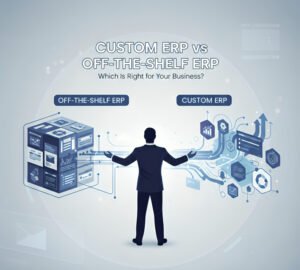
When businesses begin the ERP software comparison process, they are typically evaluating two distinct paths. Understanding the difference early prevents costly decisions later.
There are two paths:
Off-the-Shelf ERP
Pre-built. Standardized. Ready-made.
Custom ERP
Designed around your processes. Built for how you actually operate.
Both can work.
But they work for different types of businesses.
The mistake most companies make?
They choose based on price, not on operational reality.
Off-the-Shelf ERP: Fast to Start. Structured. Predictable.
Off-the-shelf ERP systems are ideal when:
- Your processes are standard.
- You are okay adapting to software rules.
- Quicker implementation is a priority.
- You want lower upfront cost.
- You don’t have highly complex workflows.
Platforms like those aligned with our implementation expertise through our partnership with Zoho provide strong modular ERP ecosystems.
Finance. CRM. Inventory. HR. Procurement.
All structured.
The advantage of packaged ERP solutions is clear:
- Lower development time.
- Proven stability.
- Faster onboarding.
- Lower initial investment.
When comparing custom vs packaged ERP, the off-the-shelf route offers predictability. Vendors have already tested the system across hundreds of businesses, which means a shorter ERP implementation timeline and faster onboarding for your teams.
But here’s the real question:
Can your business adapt to the system? Or does your system need to adapt to your business?
Not Sure If Standard ERP Fits? Let’s Assess Your Process Complexity
Where Off-the-Shelf Starts Breaking
As businesses scale, they often hit friction points with standard ERP deployment:
- Custom approval flows don’t fit.
- Industry-specific reporting is limited.
- Multi-location complexities grow.
- Advanced costing models aren’t supported.
- Unique pricing structures don’t align.
You end up:
- Adjusting operations to fit software.
- Creating workarounds.
- Maintaining side spreadsheets.
- Hiring people to “manage the system.”
That’s when ERP becomes another tool not the backbone. This is one of the most overlooked off-the-shelf ERP pros and cons: the hidden operational cost of a system you’ve outgrown.
The total cost of ownership (TCO) of an off-the-shelf platform grows quietly, through workarounds, manual reconciliation, and teams spending hours correcting what the system cannot handle automatically. These are not line items on an invoice. But they are very real costs.
If you’re already building workarounds in your current system, that’s a signal.
If You’re Managing Workarounds, It’s Time to Rethink the System
Custom ERP
Built Around How You Actually Run the Business
Custom ERP software is not about fancy features. It’s about alignment.
It works best when:
- Your workflows are unique.
- You operate in a niche industry.
- You have complex costing or pricing logic.
- You need advanced automation.
- You want full control over scalability.
Instead of asking: “How do we adjust to this software?”
You ask: “How should the system support our process?”
This is where custom ERP development services play a critical role, translating your real-world operations into a system that works exactly the way your business runs.
Custom ERP allows:
- Workflow-specific automation.
- Department-level logic.
- Tailored dashboards.
- Integrated decision intelligence.
- Industry-specific compliance structuring.
For businesses in manufacturing, logistics, healthcare, or construction sectors with strict regulatory and operational requirements i.e., custom ERP development allows for industry-specific compliance structuring that off-the-shelf platforms simply cannot provide out of the box.
The build vs buy ERP decision ultimately comes down to one question: are you building a system around your business, or rebuilding your business around a system?
But here’s the trade-off:
- Higher upfront investment.
- Longer implementation cycle.
- Requires strong process clarity.
If your processes are undefined, custom ERP will amplify chaos. If your processes are structured, custom ERP becomes a growth engine and a long-term competitive differentiator.
Explore Whether Your Business Is Ready for Custom ERP
The Real Cost No One Talks About
Let’s speak business language. The biggest ERP software comparison mistake is focusing only on license fees. The real cost is invisible:
It is:
- Poor visibility.
- Slow reporting.
- Inventory mismatches.
- Financial errors.
- Delayed decisions.
- Operational inefficiency.
An underpowered ERP creates hidden operational tax.
An over-engineered ERP creates complexity tax.
When you calculate the true custom ERP vs off-the-shelf ERP cost, including time lost to workarounds, duplicate data entry, and manual reporting, the gap between the two options often looks very different than it did at first glance.
The right ERP eliminates friction.
And friction reduction directly increases profitability.
This is what ERP selection criteria should really be built around not just licensing fees, but return on investment (ROI) across your entire operation.
Calculate the Hidden Cost of Your Current System
When Should You Choose Off-the-Shelf?
Choose it when:
- You are early-stage but growing.
- Processes are standard.
- Budget sensitivity is high.
- You want faster deployment.
- You prefer a structured ecosystem.
In many cases, we implement structured ERP frameworks powered through our experience with Zoho to help businesses move from spreadsheet chaos to centralized control.
For businesses at the early stages of digital transformation, this is often the perfect first step toward operational maturity. For many companies, that is the perfect step.
When Should You Choose Custom ERP?
Choose it when:
- You’ve outgrown standardized modules.
- You operate across multiple business models.
- You require unique cost allocations.
- You need tailored automation.
- You want a strategic system advantage.
Custom ERP is not for everyone.
But for the right business, particularly those with complex business process automation needs or multi-entity operations, it becomes a competitive differentiator that standard platforms cannot replicate.
The Strategic Question You Should Be Asking
Not: “Which ERP is best?”
But: “Which ERP aligns with how we operate today and where we want to go?”
When running your ERP evaluation, consider not just your current operational state but your 3-year scalability vision.
Think about your ERP integration requirements, how many external tools, platforms, and data sources need to connect seamlessly.
Think about vendor lock-in risk. Ask yourself whether you’re buying flexibility or committing to a fixed structure.
Technology should not restrict growth.
It should enable it.
And the wrong ERP decision creates years of friction.
The right one creates years of leverage.
Book a Clarity Session – Off-the-Shelf or Custom, Let’s Decide Strategically
Final Thought
You didn’t build your company to manage software. You built it to scale.
ERP is not about digital transformation buzzwords.
It is about operational maturity, the point where your systems actively support your decisions rather than slow them down.
At Verbine Digital, we design ERP systems aligned to your growth stage, complexity level, and scalability vision.
Whether structured implementation within proven ecosystems or fully customized architecture.
The system must serve your business.
Not the other way around.
Speak to an ERP Architect Today – Get Clear Before You Commit
The wrong ERP is expensive.
The right ERP is leverage.
Frequently Asked Questions: (H2)
1. Which ERP option is better for small businesses?
Off-the-shelf ERP is usually better for small businesses because it costs less, is faster to set up, and includes essential features. Custom ERP makes sense only if the business has very specific processes that standard software cannot handle.
2. What are the biggest risks of choosing off-the-shelf ERP?
The biggest risks include
- Limited customization
- Paying for features you don’t need
- Difficulty scaling as your business grows.
It may also require changing your workflows to match the software.
3. When should a company choose a custom ERP system?
A company should choose custom ERP when its operations are complex, unique, or highly specialized. Custom ERP is ideal if existing ERP systems cannot support the company’s workflows properly.
4. How do I decide which ERP solution fits my business?
Start by listing your business goals, budget, and current pain points. Then compare how well each ERP option supports your processes, growth plans, and integration needs.
5. What are the risks of choosing the wrong ERP system?
Choosing the wrong ERP can lead to
- Wasted money,
- low user adoption and
- operational slowdowns.
It can also limit growth and require costly replacements later.
6. Does custom ERP scale better than packaged ERP?
Yes, custom ERP usually scales better because it is built around your business model. You can add features as needed without being limited by preset software structures.
7. What are the most popular off-the-shelf ERP platforms?
Some of the most widely used platforms include SAP, Oracle, Microsoft Dynamics 365, Odoo, and Net Suite.